Your Next Interviewer Might Be an AI: What to Know
Imagine getting ready for a job interview. You straighten your shirt, check the light and take one last look at the notes beside your laptop.
Then the interview begins, and nobody is there.
A question appears on the screen. Or a voice asks it. You answer into the camera, wait through a slightly uncomfortable silence and wonder whether you were meant to keep talking.
It can feel less like meeting a future colleague and more like recording an audition for a casting director who has left the building.
That experience is becoming familiar to many job seekers. In its 2026 Candidate AI Interview Report, hiring-software company Greenhouse said that 63% of 2,950 active job seekers surveyed across the US, UK, Germany, Australia and Ireland had been interviewed by an AI. Greenhouse, which sells AI interview tools, also reported that 70% had not been clearly told in advance that AI would evaluate them.
A smaller Gartner survey of 254 candidates found that 30% were open to AI-led interviews, while 31% said they had received advance notice. In a separate survey of 2,918 candidates, Gartner found that 26% trusted AI to evaluate them fairly.
The numbers vary, but the communication problem is easy to recognize: more candidates are being asked to speak in an interview without another person visibly listening.
What counts as an AI interview?
An AI interview can take several forms.
You might record answers to questions on your own, with software analyzing the recording later; Illinois has a law written specifically for that format. You might talk to a voice-based system that chooses or delivers questions during the conversation. AI can also appear alongside a human interviewer through tools that create summaries or scores.
These systems do not all work in the same way. HireVue, for example, sells voice-based AI screening interviews, skills assessments, live-video tools with summaries and scores, and an interview assistant that can join Zoom or Microsoft Teams calls. The company said in 2021 that it had stopped using visual or facial analysis in its assessments in early 2020, while retaining speech and language analysis.
That distinction matters. Advice based on the assumption that every system scores facial expressions or eye contact may be wrong. Candidates often do not know precisely what a particular employer’s tool assesses, which is one reason advance notice and a clear explanation are important.
When the room stops talking back
A human listener gives us dozens of tiny signals. A nod tells us to continue. A smile relaxes us. A puzzled expression encourages us to explain. Even a polite “mm-hmm” helps us feel that our answer has landed somewhere.
A screen gives very little back.
Without those cues, silence feels longer. We become more aware of our own voice. Some of us rush because the empty space feels awkward; others keep adding sentences because nobody has signalled that the answer is complete. Most of us have talked ourselves past a perfectly good ending while waiting for a face to approve it.
This is the real communication challenge of an AI interview. Your structure and pace have to do work that the room would normally share with you.
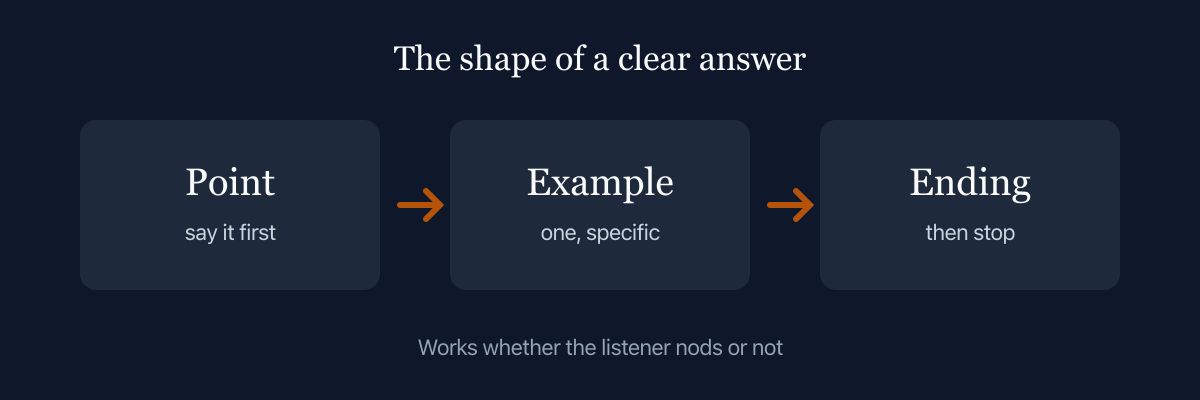
A clear beginning helps the listener understand where you are going. A focused example gives the answer substance. A definite ending prevents the strongest point from disappearing beneath three extra paragraphs.
That is good interview communication with or without AI. The unfamiliar format simply makes it more visible.
What candidates can ask about
The rules depend on where the job and candidate are located. They do not create one universal set of rights. Here is the position as of November 2026.
In Illinois, the AI Video Interview Act applies when an employer asks an applicant for an Illinois-based job to record a video interview and uses AI to analyze it. Before the interview, the employer must disclose that AI may be used, explain how it works and the general types of characteristics it considers, and obtain consent. An employer may not use AI to evaluate an applicant who does not consent.
Illinois also limits who may receive the video. If the applicant requests deletion, the employer must delete the video, including backups, within 30 days and instruct other recipients to delete their copies. Since January 1, 2026, Illinois law has also made it a civil-rights violation for employers to use AI in ways that produce discrimination based on protected classes, use ZIP codes as proxies for those classes, or fail to provide notice that AI is being used.
In New York City, Local Law 144 requires employers using a covered automated employment decision tool to have a recent bias audit and publish information about it. A New York City resident must receive notice at least 10 business days before the tool is used. That notice must identify the job qualifications or characteristics being assessed and explain how to request a reasonable accommodation under other laws.
Maryland takes a narrower approach to facial recognition. An employer may not use facial recognition to create a facial template during an interview unless the applicant signs a specified waiver. The applicant may refuse that waiver.
California regulations effective since October 1, 2025 clarify that discrimination involving automated decision systems can violate the state’s Fair Employment and Housing Act. Employers must retain related data for four years, and tests or games that elicit disability information may amount to an unlawful medical inquiry.
Colorado’s new duties begin on January 1, 2027. Employers deploying automated decision technology for consequential employment decisions will have to provide notice when a person interacts with it. Following an adverse outcome, they must provide a plain-language description of the tool’s role within 30 days. People will also be able to access and correct their data and request meaningful human review and reconsideration.
In the European Union, AI used to analyze job applications or evaluate candidates is classified as high-risk. The relevant Annex III obligations are now scheduled for December 2, 2027. Separately, using AI to infer emotions in the workplace has been prohibited since February 2, 2025, except for medical or safety reasons.
In practical terms, it is reasonable to ask whether AI will be used, what it will assess, what happens to your recording or data, and whether an accommodation or human review is available. The exact answer—and what the employer is required to provide—depends on the jurisdiction.
This is general information, not legal advice.
Practice speaking without the signals
The best preparation is not to invent a special personality for the machine. It is to become comfortable communicating when nothing reacts.
Rehearse answers aloud to a quiet screen. Record yourself, then listen back without watching the video. Can you hear the shape of the answer? Does the main point arrive early enough? Is there a clean ending?
Practice pausing after you finish. The pause before the next question may feel enormous, but it does not require another sentence. Wesleyan University’s Career Center advises candidates not to fill the entire response time when the answer is already complete. That is useful advice for any interview: completeness matters more than using every available second.
It also helps to practice telling a structured story without relying on follow-up questions. If you need a detailed preparation process, our guides cover how to prepare for a job interview and how to handle a remote job interview.
Presentr Practice lets you rehearse with an AI interviewer before you meet one: type the job or paste the posting, answer out loud, and get a scored review with coaching notes. Your first interview is free.
The goal is not to “beat” an employer’s system. You probably cannot know exactly how that system works, and pretending otherwise would only add another layer of anxiety.
The goal is simpler: to sound like yourself when the room goes quiet.
Because whether the first listener is a recruiter, a hiring manager or a piece of software, a clear answer still needs a point, an example and an ending. The screen may not nod. You can still know when you have said enough.
— The Presentr team